
• Skip to primary navigation
  • Skip to main content
  • Skip to primary sidebar
  • Get A Quote
  • 610.743.5602
  • Schedule A Meeting
default-logo
Menu
  • About
    • Team
    • Careers
    • Work
    • Who Do We Serve
  • HubSpot Agency
    • Marketing Hub
      • Setup & Strategy
        • Inbound Success Plan
        • Inbound Marketing Plans
      • Traffic Generation
      • Lead Conversion
      • Lead Nurturing
    • Sales Hub
      • CRM Implementation
      • Sales Enablement
      • Sales & Marketing Alignment
    • Content Hub
  • Digital Marketing
    • Inbound Marketing
      • Inbound Marketing Plans
    • Content Marketing
    • Email Marketing
    • SEO
    • Social Media Marketing
    • PPC Management
  • Digital Analytics
  • Web Design
    • Shopify Web Design
    • CMS Hub
    • Branding/Graphic Design
    • Our Work
    • Hosting & Maintenance
  • Blog
    • Small & Mid-Sized Business Resources
    • Client Referral Program
  • About
    • Team
    • Careers
    • Work
    • Who Do We Serve
  • HubSpot Agency
    • Marketing Hub
      • Setup & Strategy
        • Inbound Success Plan
        • Inbound Marketing Plans
      • Traffic Generation
      • Lead Conversion
      • Lead Nurturing
    • Sales Hub
      • CRM Implementation
      • Sales Enablement
      • Sales & Marketing Alignment
    • Content Hub
  • Digital Marketing
    • Inbound Marketing
      • Inbound Marketing Plans
    • Content Marketing
    • Email Marketing
    • SEO
    • Social Media Marketing
    • PPC Management
  • Digital Analytics
  • Web Design
    • Shopify Web Design
    • CMS Hub
    • Branding/Graphic Design
    • Our Work
    • Hosting & Maintenance
  • Blog
    • Small & Mid-Sized Business Resources
    • Client Referral Program

Dabrian Marketing Group

5 Tips For Making Your Data a Top Priority

June 27, 2012 by Dabrian Marketing Group Leave a Comment

Whether you’re a marketing manager for a private organization or a web analyst for a digital agency, you surely understand the great importance of data and the powerful insights it can yield. You’ve also probably encountered one (often frustrating) roadblock: The people around you just don’t get it. The business analysts haven’t gotten the historical data you requested. IT has adopted a “we’ll get to it when we get to it” approach to installing tags on the website. Upper management doesn’t share the enthusiasm that your department does.

These factors almost always lead to marketing inefficiencies for the long term, with your organization’s proverbial marketing rear-ends hanging in the wind. Without quality insights, marketing campaigns cannot improve and are ultimately doomed to fail.

Tips for Success

So how do you go about creating a data-driven culture in your organization? Check out these tips to help convey the importance of data and insights:

  1. Get Everybody On Board! – This is perhaps the most important item in this list! Measurement simply cannot happen without the complete support of the required parties in the organization. Make sure everyone, from IT to the decision-makers, knows what you are measuring, why you are measuring it, and how it affects them.

  2. Establish Data-Gathering Policies & Procedures – You’ll be measuring with the goal of gathering insights to drive business, so you will want to ensure that the data you’re basing it all upon is of good quality. Establishing policies and procedures related to data and documenting them will take some time, but it will definitely pay off in the long run.

  3. Identify KPIs Relevant to Your Audience – At this point you’ve caught the eyes of the necessary people in your organization. This is where you reel them in completely. Identify the Key Performance Indicators that matter most to each of them. This will differ according to their respective roles. You want to ensure they see the benefits of their work!

  4. Create a Measurement Plan – Once you’ve identified all of the necessary KPIs, you must map out how you’ll go about obtaining the data. Identifying opportunities for measurement and creating documentation for deployment are included in this step.

  5. Get Hyped! – You’ve put all this effort into winning the right people over. Now it’s time to get excited about it! Show them why they should be excited about the insights they’ll be receiving. The more anticipation you build, the more likely you’ll have advocates for the long haul.
Conclusion

So there you have it; 5 great tips for creating a data-driven culture. Some of them will be easier to accomplish than others, but all are possible with enough planning and communication with the right people. The benefits that can be reaped from them greatly outweigh the challenges. The insights that can be gained from complete buy-in and support can help drive business and improve campaigns well into the future.
Have additional tips? Share them in the comments!

Filed Under: Digital Analytics, Marketing Strategy Tagged With: KPIs, Measurement Planning

3 Common Pitfalls in Content Marketing

June 20, 2012 by Dabrian Marketing Group Leave a Comment

By now, you’ve probably heard about the benefits that come with incorporating a Content Marketing strategy. The ways content can enhance your business’s marketing mix, how it builds a sense of community with customers, the ways it shows off your expertise—the list goes on and on. Unfortunately, many businesses aren’t utilizing their content to its full potential. Below are the most common of these mistakes and tips on how you can avoid them.

1) It’s All About Me

Sometimes when a business decides it wants to jump on the content bandwagon, there is the mindset that the bulk of their content should be directly tied to their products / services, or that they should always try to sell something when they communicate with their audience. Unfortunately, this strategy often turns users away from your content rather than sharing it and coming back for more. The problem is that businesses often fail to step into their target audience’s shoes and think about what they like, care about, and expect from web content. People want to be informed, entertained, and assisted in solving a problem, not bogged down by constant self-promotion.

The Tip: Do your research & be customer-centric—think about who your audience is, use their feedback, and create content based on what’s important to them.

2) Nothing But The Facts

You may have heard the phrase “facts tell, but stories sell” before when it comes to Content Marketing. This point builds off the pitfall above in that users don’t want dry, isolated, or negative content; rather, they want stories. Stories have themes, compelling elements, room for engagement and interaction, and connections between them. The success of other marketing tactics, such as SEO and Social Media Marketing, rely on building content that users can relate to, find what they need, and pass on to others. This not only affects the way content is made, but also the way it is distributed.

The Tip: Have a theme & make connections—use stories to entertain, persuade, and engage with your audience.

3) Publish & Pray

In any new marketing endeavor, having a plan is essential. Not only can your business keep its efforts (and budget) organized, but it also projects a sense of reliability to customers. With your content, this step is even more important. Many businesses take a heavy-handed approach to their content, letting regular communications fall by the wayside. Customers don’t want to keep checking your site for new content only to find the same thing they saw the week before. In most cases like this, they’ll eventually stop returning. Applying an optimization plan (set a goal, plan, implement, measure, refine, & repeat) is a great way to look at the content creation process.

The Tip: Make a plan & stick to it—create a calendar for content to show that your business can maintain a high standard while enhancing your reputation to your audience.

What do you think of the pitfalls above? If you have any suggestions or questions about this list, leave us a comment below!

Filed Under: Content Marketing, Marketing Strategy Tagged With: content, marketing, pitfalls

3 Steps to a Successful Strategic PPC Campaign

June 14, 2012 by Dabrian Marketing Group Leave a Comment

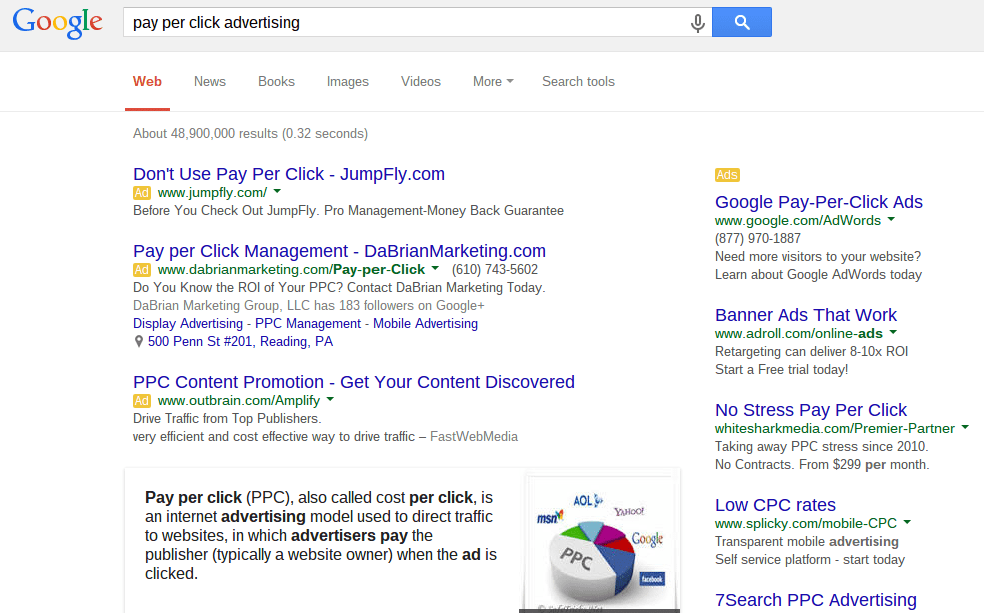
Exampale Pay per Click Advertising
Exampale of PPC Ads on a Google search engine reuslts page

Pay per Click (PPC) are the paid ads the show above and and along side of the search results, when you use Google, Bing, or other search engines. PPC can be a very powerful form of advertising. Google and Microsoft often brag about its amazing reach and how cost-effective it is. However, like everything else in business, if your PPC advertising efforts are aimless, then the profitability will most likely not be there. In order to not waste your time and money, here are 3 Steps (Strategy, Implement, and Optimize) to consider prior to running a Pay per Click Campaign.

1) Strategy

First ask the all important question: Why? What is your purpose of advertising online? This begins the strategy building process, which all starts with an overall objective – Increase brand awareness, generate leads, drive more sales, etc. This defined objective gives your PPC Campaign a focus. Next, decide how much you are willing to spend. Your budget is best set either monthly or daily. The final stage of the strategic process is setting specific and measurable Goals – i.e. to increase sales 3% month over month.

2) Implement

Now that you have an objective, budget, and at least one goal, the next step is setting up the Campaign. Before heading to Google AdWords or Microsoft adCenter, you will want to do some research. A few questions to consider are – Who is your target audience (broad or niche), what are they searching (keywords), and where are they online (websites, Social Media, etc.)? With all of this newly found information, it is time to head to the most appropriate advertising platform(s) (AdWords, adCenter, Facebook, etc.) and set-up your PPC Account. Remember to include multiple ad copy variations, keyword match types, and landing pages for testing purposes, because it is never too early to begin testing to see what will be the most effective and efficient.

3) Optimize

Finally, your PPC is up and running. The last step is to monitor its performance and make adjustments accordingly. Re-visit your goal(s) and determine all your Key Performance Indicators (KPI’s), not just the final goal metric. For example, if your goal is to increase sales 3% month over month, your KPI’s would include:

  • Impressions – Number of times the ad was shown

  • Clicks – How often your ad was engaged with

  • Conversions – Sales, Lead Generation, Phone Calls, etc.

  • Cost – Cost/Click and Cost/Conversion

  • ROI – Measure and show Profitability

Between checking the important KPI’s and continuously testing different elements (Ad Copy, Landing Pages, Keywords, etc.) of your PPC Campaign, you will be able to make the modifications needed to ensure that you reach your goals and objectives.

To summarize, Pay per Click can do wonders for your business, but you have to put work into it, rather than just running it aimlessly. Start with putting together a strategy. Use that strategy to guide you through the set-up and targeting process. Finally, stay focused on your business’s goals as you monitor, test, and optimize your PPC Campaigns. This simple, yet time-consuming and work-intensive 3-step process will help you build and manage an effective and efficient PPC Campaign.

Filed Under: Paid Search (PPC) Tagged With: AdWords, Bing Ads, PPC

Top 5 Features of Google Analytics Content Experiments (vs. Website Optimizer)

June 6, 2012 by Dabrian Marketing Group Leave a Comment

For about 5 years now, marketing professionals have been using Google’s Website Optimizer to run A/B tests and Multivariate tests on webpages. Google recently announced that Website Optimizer will be replaced with Content Experiments. Content Experiments offers similar functionality as Website Optimizer with a few limitations; however, I’ll highlight the top features that I think Content Experiments offers. Here are my top 5 features for Content Experiments when compared to Web Site Optimizer:

1. Experiment Integration within Google Analytics

Content Experiment’s integration within Google Analytics is much improved compared to Web Site Optimizer. Web Site Optimizer did not integrate with Google Analytics, which limited a user’s ability to obtain additional information about the test variations for each experiment such as time on site, bounce rate, or the possibility of segmentation.

2. Simplified Workflow with the Set-up Wizard

The simplistic workflow to implement an experiment is streamlined as well. The process went from 5 basic steps to 4 basic steps. The set-up wizard for the experiment clearly identifies where you are within the set-up process and the next steps. In addition, there are icons to help you throughout the process to understand what you’re doing.

3. Visuals of the Experiments within the Console

The simple workflow is enhanced with visuals of the experiment variations, which was not part of Web Site Optimizer. Within the console of Google Analytics Content Experiments, you can see exactly what your original design vs. the variation(s) will look like prior to launching the experiments.

4. Better, More Simplified Reporting

In my opinion, the reporting in Content Experiments is much better than before. Content Experiments provides high-level experiment detail at a glance (visits, days of data, status of the experiment, and percentage of included visitors). The conversion data is also much improved by providing separate columns for visits, conversions, conversion rates, and basic green & red arrows to compare the variation(s) to the original page. Finally, the look of the reports is now more consistent with the newer Google Analytics interface.

5. Rewrite the Variation URLs to the Original within GA Content Reports

By selecting to rewrite the URL variations, you can consolidate all of the traffic to your original and variation pages. These URLs will appear under the original page within your Content Reports. This ability makes the Content Reports easier to read and streamlines the analysis of the experiment’s impact on page metrics in addition to its data. This provides increased functionality with custom reporting and experiment segmentation.

What’s the BIG Deal with Content Experiments?

The simplified shift from Web Optimizer to Content Experiments will save companies and marketers’ time, money, and allow them to easily create testing experiments. Ideally, Content Experiments will reduce the amount of time to create experiments and simplify their data, making them easier to understand as well as more actionable. With more actionable information, companies and marketers should be able to improve their users’ online experience and generate higher conversions.

Get off the excuse bandwagon! Start experimenting for better lead generation and online sales, what are you waiting for? Leave your feedback on Content Experiments in the Comments section below!

Filed Under: Digital Analytics, Google Analytics Tagged With: content, experiments

Want to Improve Your Advertising? Align Your Measurement Strategy With the Right KPIs

May 30, 2012 by Dabrian Marketing Group Leave a Comment

The ability to measure nearly every facet of marketing campaigns and websites is nothing new. Solutions have existed for several years now and are continuously receiving updates, improvements, and new features that allow for even more in-depth analysis of customer and visitor trends. Tools like Google Analytics even allow for tracking of everything from your business’s website, to social media interactions, to your television ads (just to scratch the surface). With such a powerful (and free) tool available, there is really no excuse NOT to have insight into your initiatives!

With such a robust arsenal available to today’s marketers, however, it can become quite tempting to report on every available piece of data. While much of this data is indeed important, only a small selection of them does a good job of gauging the impact of marketing and advertising effectiveness.

So your organization chose an analytical tool to measure its campaigns and website: What should your measurement be focused on? Key Performance Indicators (KPIs)!

KPIs and You

KPIs are metrics and insights that are used to measure the success of a website or campaign. These KPIs typically demonstrate the success of your website at accomplishing the tasks it was designed for.
In order to identify KPIs for measurement, you must first determine the purpose of your organization’s website or campaign. In the case of the above visual, the website exists to generate brand awareness, increase leads, and increase sales. Once you’ve identified these high-level goals, you must then look at what your analytical tool can measure and align the right metrics to the appropriate goals. For example, the amount of new visitors and direct traffic to the website are great indicators into its ability to generate brand awareness. Keep in mind that these KPIs shouldn’t always be limited to a single tool! In some cases, they may even require insights into foot traffic (i.e. increases in foot traffic to a branch or ATM).

Want to impress the decision-makers even more? Use those KPIs to demonstrate Return on Investment! The people with the power to allocate budgets and make decisions often glaze over when presented with standard metrics. While they will definitely be impressed with the KPIs you’ve come up with, showing them ROI on the marketing budget will knock the ball out of the park. This requires that you have visibility into profit margins for a given initiative. If that isn’t readily available to you, you might want to find out how to get it!

Conclusion

It is imperative that KPIs are identified with any measurement strategy, as they greatly benefit all facets of your business. They can help individuals in your team identify opportunities for increased efficiencies. Campaign performance can be easily determined by the marketing department, which would then allow for improvements. Your entire business benefits from a solidified base in measurement and improvements, and KPIs can be great building blocks for that foundation.

Filed Under: Digital Analytics, Google Analytics Tagged With: advertising, align, measurement, strategy

Picture This—The Role of Infographics in Content Marketing

May 23, 2012 by Dabrian Marketing Group Leave a Comment

What are Infographics?

In short, an infographic is any visual representation of information. These large, creative images (see below for an example) can be found in a variety of places around the web, like on blogs, through some social networks like Pinterest, and on bookmarking sites like StumbleUpon. For the purposes of Internet Marketing, an infographic is normally used to present a large amount or complicated data in an appealing and engaging way. And that’s the key to your business getting the most out of this kind of content—engagement with your target audience. The assumption always seems to be that web users are impatient—they won’t bother with a site if it doesn’t load after a few seconds, and they won’t take the time to read every word on a text-rich web page. To market in this environment, where users want information in (faster than) an instant, visual content like infographics just might be a way to slow people down and get your message across effectively.

How can I use Infographics for Marketing?

Just like any other visual-based piece of content, the marketing value of infographics lies in their portability, opportunities for sharing via social networks, and linking back to your business’s web site.

Portability: Once designed and completed, an infographic can be easily uploaded to an aggregator, repurposed in a presentation, highlighted in an email promotion, or discussed in an article, blog post, press release, or social media post.

Sharing: Your business’s online presence, reach, and credibility can all receive a substantial boost when users share your visual content. Because of their relatively small size and wide range of applications, infographics make for an inexpensive chance for your business’s content to “go viral.”

Backlinking: Just because any text content within an infographic can’t be crawled or indexed by a search engine doesn’t mean that these images don’t have distinct SEO advantages. Anyone that shares and/or publishes an infographic somewhere else typically links back to your business’s website; this link bait results in greater traffic and a higher search ranking.

Conclusion

It’s easy to see the benefits that can come not only from infographics, but from the integration of any visual content into your business’s digital marketing plan. The key is that the content has to be well designed. The best images are appealing and easy to understand, as well as informative and engaging. They can show your business’s expertise on a particular subject as well as increase your reach and web traffic. Finally, infographics are easily repurposed, shared by users, and serve as effective link bait for SEO purposes. For a business owner, it seems a picture can be worth much more than a thousand words.

Filed Under: Content Marketing, Search Engine Optimization (SEO), Social Media Marketing & Management Tagged With: content, infographic, marketing

  • « Go to Previous Page
  • Page 1
  • Interim pages omitted …
  • Page 43
  • Page 44
  • Page 45
  • Page 46
  • Page 47
  • Page 48
  • Go to Next Page »

Primary Sidebar

Archives

Categories

Subscribe Now


CONTACT INFORMATION

DaBrian Marketing Group
3535 N. 5th Street HWY
Suite 2, #203
Reading, PA, 19605

  • 610.743.5602
  • Mon - Fri: 9AM - 5PM
Contact Us
Web Support

RESOURCES

  • Case Studies
  • White Papers
  • eBooks
  • Small Business Resources
  • Our Blog

MARKETING

  • Financial Services
  • Health & Wellness
  • Ecommerce & Retail
  • Business 2 Business
  • Business 2 Consumer

VISIT OUR LOCATION

  • Get Map & Directions

CONNECT WITH US

Facebook Instagram Linkedin Rss Twitter Youtube

Copyright © 2026 DaBrian Marketing Group  •  All Rights Reserved  •  Privacy Policy •  Terms & Conditions

Scroll Up