• Skip to primary navigation
  • Skip to main content
  • Skip to primary sidebar
  • Get A Quote
  • 610.743.5602
  • Schedule A Meeting
default-logo
Menu
  • About
    • Team
    • Careers
    • Work
    • Who Do We Serve
  • HubSpot Agency
    • Marketing Hub
      • Setup & Strategy
        • Inbound Success Plan
        • Inbound Marketing Plans
      • Traffic Generation
      • Lead Conversion
      • Lead Nurturing
    • Sales Hub
      • CRM Implementation
      • Sales Enablement
      • Sales & Marketing Alignment
    • Content Hub
  • Digital Marketing
    • Inbound Marketing
      • Inbound Marketing Plans
    • Content Marketing
    • Email Marketing
    • SEO
    • Social Media Marketing
    • PPC Management
  • Digital Analytics
  • Web Design
    • Shopify Web Design
    • CMS Hub
    • Branding/Graphic Design
    • Our Work
    • Hosting & Maintenance
  • Blog
    • Small & Mid-Sized Business Resources
    • Client Referral Program
  • About
    • Team
    • Careers
    • Work
    • Who Do We Serve
  • HubSpot Agency
    • Marketing Hub
      • Setup & Strategy
        • Inbound Success Plan
        • Inbound Marketing Plans
      • Traffic Generation
      • Lead Conversion
      • Lead Nurturing
    • Sales Hub
      • CRM Implementation
      • Sales Enablement
      • Sales & Marketing Alignment
    • Content Hub
  • Digital Marketing
    • Inbound Marketing
      • Inbound Marketing Plans
    • Content Marketing
    • Email Marketing
    • SEO
    • Social Media Marketing
    • PPC Management
  • Digital Analytics
  • Web Design
    • Shopify Web Design
    • CMS Hub
    • Branding/Graphic Design
    • Our Work
    • Hosting & Maintenance
  • Blog
    • Small & Mid-Sized Business Resources
    • Client Referral Program

Dabrian Marketing Group

Giving Thanks to SEO

November 25, 2015 by Dabrian Marketing Group Leave a Comment

Thanksgiving is a popular Holiday for many Americans. The abundance of delicious foods and the gathering of family and friends is certainly something to get excited about. Traditionally in most households, members are sitting around the table saying what they are thankful for in their lives. Here at DaBrian Marketing, we wanted to give thanks for Search Engine Optimization (SEO) by offering some tips to assure your website performs well.

Cover the Entire Table of Local Listings

When you think of Thanksgiving dinner, you imagine a table covered in food, right? The same is true for an effective SEO campaign in regards to local listings. Local listings are becoming an increasingly important ranking factor. People are frequently using search engines with local intent. In fact, a study by Google shows that 4 in 5 consumers use search engines to find local information such as a business’s address, hours, and products/services offered.

Imagine your listings as different dishes. Being listed on Google my Business, Bing Places, and Yahoo Local listings should be your top priority. This is the main dish, the turkey. But don’t forget about the side dishes either. Being listed on other platforms such as Yellow pages, Yelp, Foursquare, etc, help as well. These are your stuffing, your mashed potatoes, and your cranberry sauce. The more you have covered, the better your meal (website’s performance) will be.

When preparing your Thanksgiving feast, you want to make sure everything is perfect. Before you place the food on the table, you should give it a taste test just to make sure. Similarly to SEO, you need to make sure your listings are perfect as well. This means claiming and verifying your listings, as well as making sure the listings are completely filled out and are consistent with each other.

Know Your Audience: Invite Relevant Traffic to Dinner

Thanksgiving isn’t just about food, it’s also about spending time with those who matter the most. When planning your celebration, you invite the most important people in your life. The same is true for SEO. As a business owner, those who matter most to your business’s success are your customers. So how do you invite them to your site? Well, it all starts with your content. If you regularly develop great content that speaks to your audience’s interests, relevant traffic will increase.

Besides stuffing our faces at the dinner table, we also engage in conversations with our family and friends. They speak to us, and naturally, we respond back. This same formula should be followed for social media. As stated in my previous blog about SEO predictions for 2016, content marketing and SEO have merged. This means that businesses must be active on their social media accounts, providing great content frequently, and engaging with their followers. An effect social media strategy will help develop relationships with your followers, which typically leads to them sharing your information with others, increasing your brand’s awareness. All of this comes back full circle to an increase in customers and sales.

Stuffing? - Yes; Keyword Stuffing - NO!

Now we all know stuffing is a must have dish at Thanksgiving. However, for SEO, keyword stuffing is a must avoid. In April of 2012, Google released the algorithm change known as “Penguin” designed to penalize for keyword spamming. While there is technically no optimal percentage for keyword density (how often your keyword appears within your content), your content should sound natural. Here’s an example of what not to do:

“At DaBrian Marketing, we offer Pay Per Click services. Our Pay Per Click services help businesses drive traffic to their site. For more information on Pay Per Click, please contact our Pay Per Click consultant.”

The use of Pay Per Click is obviously being overused. Not only does it sound spammy to the user, but your site will be penalized by search engines. Here’s an example of how to adjust your content to avoid keyword stuffing:
“At DaBrian Marketing, we offer Pay Per Click (PPC) services that are proven to help businesses drive traffic to their site. For more information, please contact our PPC consultant.”

SEO Tips - keyword stuffing

Invite Your Guests Back and Tell Them to Bring a Friend

So the dinner went well and you and your guests had a great time. More than likely you are going to send invites to those guests again. The same mentality should be true for SEO. You should send follow up emails to users that request or fill out any information. This will give you an opportunity to give more information about your business and to set yourself apart from the competition. If done properly, these will more than likely lead to more conversions.

People usually do not wish to hear others critique their cooking, but as a business owner, you want reviews. Traditionally, business owners have cringed at the thought of their customers giving reviews out of fear that they’ll be negative. While a negative review may not shed the best light on your business, it offers you an opportunity to humanize your brand by listening to your customer’s concerns, which leads to trust being established. In fact, A study by Reevoo, a social commerce company, found that 68% of consumers trust reviews more when they see both positive and negative scores, while 30% suspect censorship or fake reviews when they don’t see anything negative at all. Reviews give business owners an opportunity to adjust their recipe and make things right through great customer service.

Conclusion:

An effective SEO campaign is something a business will be thankful for. Not only will it help a business’s site perform well in search engines, but it will also help increase traffic, as well as sales. From all of us here at DaBrian Marketing Group, we hope you and your loved ones have a Happy Thanksgiving!

For more advice or information about SEO, please Contact Us today or leave us a comment below!

By: David McDowell

Filed Under: Search Engine Optimization (SEO) Tagged With: digital marketing, internet marketing, local seo, search engine optimization, seo, SEO strategy, tips

Happy Veterans Day From DaBrian Marketing Group

November 11, 2015 by Dabrian Marketing Group Leave a Comment

From everyone at DaBrian Marketing Group, we would like to say thank you to the men and women in uniform for the sacrifices you’ve made and thank you to all of those that have served or continue to serve our country. Happy Veterans Day.

Veterans Day

Filed Under: News & Events Tagged With: thankyouforyourservice, VeteransDay

How Mobile Friendly Design Impacts Your Website

November 4, 2015 by Dabrian Marketing Group Leave a Comment

Why Should Your Site Be Mobile Friendly?

It is no secret that mobile usage has grown in recent years. Over 20% of Google searches are done on mobile devices, and 25% of internet users conduct their online search on only mobile devices. If your site isn’t mobile, do you think it will still show up in the search results? Google updated their search algorithm back in April. Mobile users that use Google, with Google being the most popular search engine, will only see mobile friendly sites. If your site is not mobile, you will not appear in theses results. To read more about the Google algorithm change, check out our blog on it.

Why Mobile Design Matters

So what does all that mean for your business? If your site is not mobile-friendly, you’re completely missing at least 1/4th of potential customers. According to Think with Google, 94% of Americans with smartphones search for local information on mobile. Meaning you’re missing even more potential customers as well as your current customers are having a bad user experience by not being able to find you.

Users will look at products on mobile devices and revisit later on their desktop hoping their shopping cart is synced. The longer it takes for them to check out the more likely they will not complete the sale. In a study by MediaPost, 48% of shoppers that use their phone said that “ease of use” is the most important quality they look for on a mobile site.

bad mobile
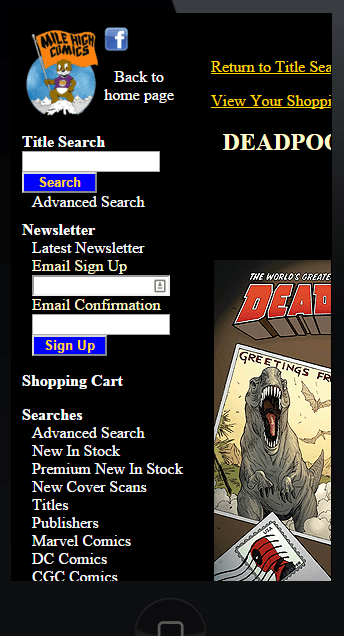
Horizontal scrolling, mismatch of colors, forms too small. What not to do.
mobile friendly
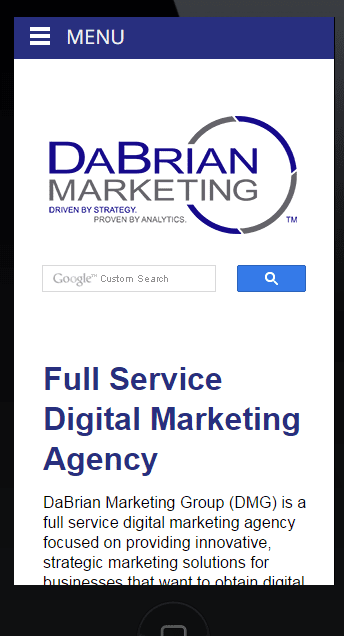
Only need to scroll down. Menu stays at the top as you scroll. This is all good.

What To Consider When Designing For Mobile

You want to go mobile friendly now but not sure what to consider. For starters, any buttons and links should be big enough for anyone’s thumb to click and not have issues. Meaning, it needs to be fairly big. Your “Contact Us” form is the same way as the user needs to interact with it. If it is too small, when they click on one thing they will get a different option making them frustrated and have them potentially leave your site.

If a user is on their mobile phone, chances are they are hunting for something specific and your site can only be 1 column. Get rid of excess and unneeded info / elements. For example, if you have a sidebar on every page with info like a form for them to fill out, blog options, register options, it’s best practice to get rid of them for mobile. You don’t need to shorten your content at all, you’re just making all the useful information easier to find.

Got questions about mobile first design? Ask away in the comments below!

Filed Under: Mobile Marketing, Search Engine Optimization (SEO), Web Design Tagged With: mobile, Mobile marketing, mobile optimization, mobile website

Are You Afraid of PPC Advertising?

October 28, 2015 by Dabrian Marketing Group Leave a Comment

With Halloween in a few days, we want to look into why some small business are afraid to run PPC advertising campaigns. After taking a closer look at some of the spooky aspects of PPC, hopefully, you will find that it is not scary, but that Pay per Click is an opportunity to help you increase leads and sales for your business. Here are the top 3 reasons small business are afraid of PPC:

1. Scary Expensive or Scared of Wasting Marketing Budget

Sure you can set a daily and monthly budget to control cost, but that doesn’t mean that it is being used wisely. Did you know that you can schedule your PPC ads to only run during specific hours of the day to maximize the effectiveness of campaigns with limited budgets? In addition, there is geo-targeting for localized businesses, and device specific bidding if mobile or desktop traffic is more valuable for your business. If you are already running PPC, these are a few settings that you might want to check to ensure you are getting the most out of your campaigns.

PPC Advertising Halloween

2. Scary Results (or lack thereof)

As a digital marketing agency, we hear “PPC doesn’t/didn’t work for our company/industry.” Really? Are you sure? Before you dive into doing PPC advertising, set your goals and know how you are measuring success. Are you trying to generate phone calls, form submissions or online ecommerce sales? Whatever the end goal might be, set-up Conversion (or goal) tracking. This can be done within the PPC platform (Google AdWords, Bing Ads, etc.), but ideally it is set-up through web analytics (Google Analytics.) Connecting web analytics to your PPC will allow you to see beyond the basic Impression and Click data, and uncover if there is a problem with your landing page(s) or conversion funnel/process.

If you are already running PPC but are not currently tracking conversions, then this is something that you should set-up ASAP. We cannot imagine anything scarier than spending marketing dollars and having no way of knowing/measuring the return!

3. Scary Complicated and/or Too Time Consuming

Pay per Click may seem simple and easy at first, but there is a reason Google requires a person to pass 2 of 6 different PPC proficiency exams to earn their AdWords Certified status. To properly setup and manage an account one needs to know the ins and outs of the AdWords platform and understand how search (both paid and organic) works. While there are several tools available to help make monitoring and management easier, these are only tools. The person using the tools still needs the skills and know how to make the most out of the tools. For instance, a carpenter can do a lot more with a saw and hammer then a chef can.

If you don’t have the time to learn, set-up and manage your own PPC advertising, we highly recommend that you seek help from someone certified (Google AdWords or Bing Ads) to help manage your PPC. Before you seek the help of just anybody, make sure that you have FULL access to your account and that if for any reason you decide to fire/disconnect from them managing your PPC, that you get to keep your account. Because the second scariest thing we can think up is not having any insight/access to your own PPC account.

Even though PPC can be scary and be a daunting task for some companies, if you take the time to truly understand the value of PPC and its ability to gain leads and sales and reach potential customers, then there should be no reason to be afraid of PPC advertising.

Filed Under: Ecommerce & Retail Marketing, Google Analytics, Paid Search (PPC)

5 SEO Predictions for 2016

October 21, 2015 by Dabrian Marketing Group Leave a Comment

Search Engine Optimization (SEO) is an on-going and always evolving process. This year we saw several updates such as Google’s Mobilegeddon. With this year shortly coming to an end, here are 5 SEO predictions businesses can expect to see in 2016.

1. Mobile is Key

According to the Pew Research Center, 64% of Americans have a smartphone and 42% own a tablet. With continuous technological advancements, smart technology is becoming more readily available. Due to this, mobile traffic has been steadily increasing and you can only expect it to go up. In fact, Google announced this year that more Google searches take place on mobile devices than computers in the US.

What does this mean for your business?

First thing’s first, you need to have a responsive design to comply with Google’s mobile- friendly algorithm change. That means that the layout of your site will change depending on which device the viewer is using it on, so that it will be visually appealing. Besides the technical aspect, you also must think with a mobile mindset. Give your viewers a better user and visual experience by utilizing spacing, highlighting the most important parts of your site, and increasing the size of touch buttons to help improve the ease of use.

2. Local SEO will be HUGE!

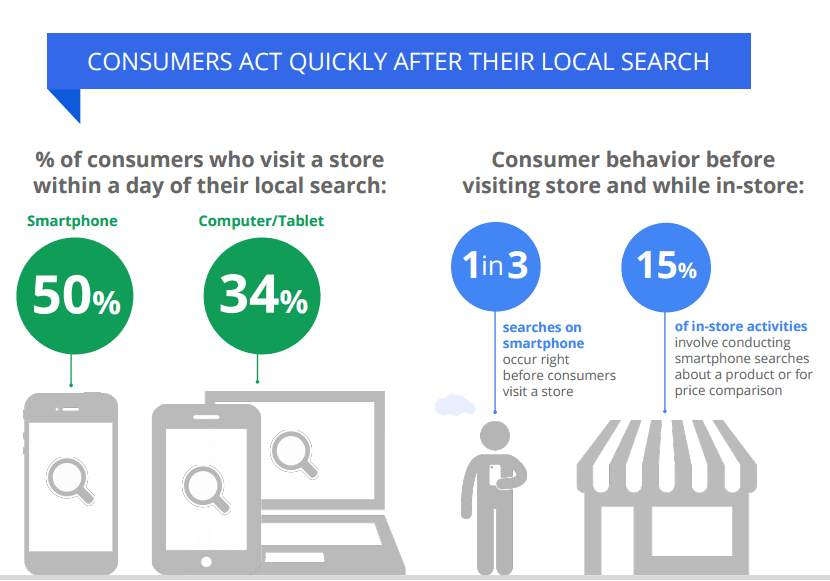
A study by Google shows that 4 in 5 consumers use search engines to find local information such as a business’s address, hours, and products/services offered. The study also shows that 50% of consumers who conducted a local search on their smartphone visited a store within a day.

Screen Shot 2015-10-21 at 3.46.10 PM

How to make sure your business isn’t dropping the ball

One of Google’s and other search engine’s biggest ranking factor is your company’s NAP (Name, Address, and Phone Number). Search engines want to see your contact information clearly stated and consistent not only across your site but also in other listings across the web. To make sure your site performs well, update and verify your local listings across platforms such as Google My Business, Bing Places, and Yahoo local.

3. The Increase of Voice Search

Voice searches have become increasingly popular thanks to the emergence of Apple’s Siri, Google’s voice recognition, and other voice recognizing software. As they become more useful and efficient, people will begin to voice search more often as opposed to typed search.

So how is voice search any different from typed search? Well, voice searches are usually longer and more question focused whereas typed searches are typically straight to the point. For example, a voice search may be, “Where is the closest pizza restaurant in Reading?” A traditional typed search would most likely, “Pizza restaurant Reading.” Voice searches tend to start who, what, when, where, why, and how.

This not only means your local listings should be up to date and verified, but you should develop your content with these questions in mind. If your content answers these questions, you’ll have a satisfied user which tends to translate to a lead or sale.

This also changes your keyword selection and management. Long tail keywords are now more important since voice searches contain more words. For example, instead of just having the keyword “SEO,” you should also look into “how to improve your SEO.” Below is a chart from Microsoft showing the difference between voice and typed searches in terms of keyword length.

Voice Search SEO

4. Merge SEO Strategy with Content Marketing

In the past SEO and Content marketing have been separated. SEO was thought to have been more technical whereas content marketing was creating high-quality content with the intention of retaining customers. Google and other search engines have put a huge emphasis on the user experience and will continue to do so. If you want to have a successful SEO campaign, you’ll have to understand that content is king, and the user experience is what matters the most. Thus, businesses must become active bloggers and also become active on social media. They should share their content and other helpful content as well. This will help build organic links from reputable sites which will increase your brand reach and visibility. All of this comes back full circle to an increase in customers and sales.

5. Bing is on the Rise

While it is obvious Google owns the Lion’s share of the search engine market, do not forget about Bing. Bing is now integrated will Apple’s voice assistant Siri and on top of that, Google and Apple’s search contract for Safari is coming to an end. Bing will have a great opportunity to land that contract. Bing is also integrated with Cortana, Microsoft’s voice assistant, which is packaged with Windows (8.1 and 10) PC and Mobile as well as Xbox 360. According to Netmarketshare.com, Bing is integrated into over 17% of operating systems. If they are able to lock in the Apple search contract, that would push them over 22%. This means that businesses must be aware that there are more search engines than just Google. To avoid missing out on Bing, update and verify your listings on Bing Places to make sure they’re accurate and consistent.

Conclusion:

The main takeaway to help prepare your business for 2016 from an SEO perspective is to be mobile-minded and to be listed accurately and consistently across all platforms with content based around the user experience. If your business can accomplish that, there is no reason why your SEO campaign won’t be successful.

Contact us today or leave us a comment below for more advice or information!

By: David McDowell

Filed Under: Mobile Marketing, Search Engine Optimization (SEO) Tagged With: local seo, mobile seo, seo, SEO strategy

How to Import Cost Data

October 14, 2015 by Dabrian Marketing Group Leave a Comment

What Is Cost Data And How Can Importing Cost Data Help Your Business?

Importing cost data into Google Analytics means having efficient and accurate data which brings you up to speed with your costs and ad spend. Cost data is the data from different non-Google social media platforms that provides information on impressions, clicks, costs, keywords, ad group, campaign and much more. Importing cost data means saving your time and money. This is all important because it allows you to perform Return On Investment (ROI) analysis and compare campaign performance for all online advertising and marketing platforms in Google Analytics. There are also many other ways you can import cost data from multiple sources into Google Analytics. Manually importing the cost data into Google Analytics is a low-cost method with simple steps.

Google Analytics Data Set Setup

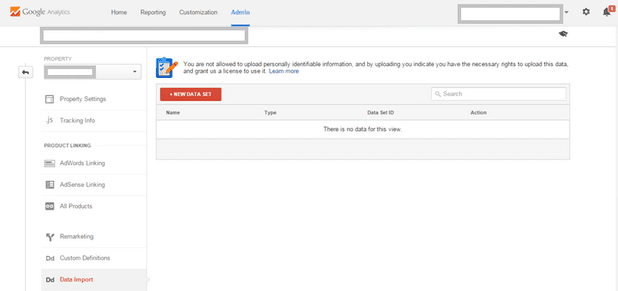
You first begin by going into Google Analytics and creating a data set type, name, and schema. The data set type is the type of data you want to import, in this case it will be cost data. The schema is the outline of the plan that joins the data you upload with the existing data. The schema helps translate the dimension and metric to something Google Analytics would be able to understand. In order to do this, you must have access to the account, property, and view (company name, division, and where you want your data to go) in Google Analytics. Once you have selected the account, property, and view (company name, division, and where you want your data to go) in which you wish to import your cost data to, then click on Admin. Once you click on Admin, under property, click on the label called Data Import. A new screen should pop up, allowing you to add a new data set.

There should be a red button that says  “+New Data Set,” click on it. Below is an example of where you should start to set up the data set. Now you will have to fill out the data set type, name, and schema. Once again, the schema helps translate the dimension and metric to something Google Analytics would be able to understand. Starting with the data set type, choose the type of data you would like to import. In this case, you are importing cost data, so you would choose cost data under Summary Data Import. Next, is putting in the data set details such as the name and views you want the data to be seen in. The final step would be setting the data set schema. To do this choose the columns that you want to import data for, such as Click, Cost, Source, etc. Now that you setup the data set within Google Analytics, you can move on to getting your cost data.

“This can help you organize, analyze and act upon this unified data view in ways that are better aligned with your specific and unique business needs.” - Google

Obtain Cost Data From Source

The second step is to get the cost data from the source (Bing Ads, Facebook Ads, etc.). Keep in mind it should be a CSV file. You can do this by logging in to Bing Ads or another source. The CSV file will most likely have columns that need to be excluded, which will be described in the upcoming steps. Now that you have the cost data from the source, you need to fix the format of the CSV file.

Match CSV file with data set schema

The third step is setting up the CSV file to match the data set schema you created in Google Analytics. A schema is the structure of the plan that joins the data you upload with the existing data. Impressions, Medium, Source, Clicks, and Cost are some example of what a schema consists of. However, if one was to simply import these figures into Google Analytics there would be an error. In order to make the schema match, you must translate it.Google Analytics needs to understand what metrics are included in your data, so in order to do this we need to translate the metrics. Below is an example of a correctly formatted header, it is an example of a schema. Anything extra added from this schema won’t work. To import data, Google Analytics looks for a match with the file you are importing. When a match is found, the dimension and metric values associated with that data set are added to the existing data. Then, the data is available to be seen and analyzed within Google Analytics. While formatting the CSV file, there are two important factors to remember. The first factor is: don’t forget to include the date of the cost data, it would be translated to “ga:date.” The date needs to be formatted so it is YYYYMMDD. Any other format of the date will cause an error. The second factor is: make sure that each column that is labeled is filled, there should be no empty rows and columns. Now that you have matched or translated the schema over to the CSV file, you can upload it to Google Analytics.

Upload file into Google Analytics

The fourth step is to upload the cost data (CSV file) into Google Analytics. In order to do this, go to Google Analytics and choose the account, property, and view you want to import the cost data into. Then under admin, click data import, click manage uploads on the data set you created to upload the cost data. Next, click upload file and then choose the file you wish to be uploaded into Google Analytics.

Status of Cost Data file

The fifth step is to check the status of the cost data. It will take about thirty seconds for the file to upload. It will first say pending. If it has successfully uploaded you should be able to see the completed status under the data set you have created. If there is a failed status, you should be able to see the errors you made. You can fix them in the CSV file and upload the cost data once again.

How to view imported Cost Data into Google Analytics

The sixth step is if and only when you have successfully uploaded the cost data into Google Analytics, and can now view it. In order to view it, in Google Analytics pick the account/property/view in which you uploaded the cost data and then go to reporting. To see the cost data in Google Analytics, on the left side of the screen there should be a sidebar with many options. Click on acquisition and then campaigns, and then finally cost analysis. Cost analysis should appear and hopefully you should be able to see the upload cost data under the source/medium you imported. If you don’t see your cost data listed, I would recommend setting the date in Google Analytics to the date that your cost data has been uploaded to. Otherwise, after the CSV file is uploaded you should be able to see the accurate cost data.

Conclusion

Importing cost data helps business professionals save time and efficiently analyze the data. Importing cost data can change the whole prospect of a business’s ROI and campaign performance while comparing it to other advertising and marketing platforms.

Start importing your cost data, save your time and money. Contact us today or leave us a comment below for more advice or information!

Filed Under: Digital Analytics, Google Analytics Tagged With: cost data, Google Analytics

  • « Go to Previous Page
  • Page 1
  • Interim pages omitted …
  • Page 20
  • Page 21
  • Page 22
  • Page 23
  • Page 24
  • Interim pages omitted …
  • Page 48
  • Go to Next Page »

Primary Sidebar

Archives

Categories

Subscribe Now


CONTACT INFORMATION

DaBrian Marketing Group
3535 N. 5th Street HWY
Suite 2, #203
Reading, PA, 19605

  • 610.743.5602
  • Mon - Fri: 9AM - 5PM
Contact Us
Web Support

RESOURCES

  • Case Studies
  • White Papers
  • eBooks
  • Small Business Resources
  • Our Blog

MARKETING

  • Financial Services
  • Health & Wellness
  • Ecommerce & Retail
  • Business 2 Business
  • Business 2 Consumer

VISIT OUR LOCATION

  • Get Map & Directions

CONNECT WITH US

Facebook Instagram Linkedin Rss Twitter Youtube

Copyright © 2026 DaBrian Marketing Group  •  All Rights Reserved  •  Privacy Policy •  Terms & Conditions

Scroll Up